
Swallowed by the Red Tide
How China Ate Canada

A sweltering day in mid-July, 1995.
I’m sitting on the grass beneath my friend’s basketball hoop. He had an adjustable hoop in his driveway—the first kid in the neighborhood to have one—so naturally this was the meeting place for all kids in a six block radius during summer break.
I don’t believe we ever actually played a game of basketball in that driveway. Since we could lower the hoop to a height that would allow us to dunk, nearly all of my memories consist of slam dunk competitions. Every day my friends would argue over who’d get to be Michael Jordan—and if one was smart enough to wear a Jordan jersey that day, then of course the honor was bestowed upon them by default. Myself, being the contrarian that I am, I always chose to be Dominique Wilkins: a lesser known player but one who real basketball fans would acknowledge as a more than respectable choice.
The chatter amongst this group of faux NBA all-stars is suddenly interrupted by the piercing squeals of screeching tires. My friend’s dad leaps out of his Toyota and darts toward the neighbors who are unloading something from their car across the street.
His voice cuts through the still summer air and turns hoarse as he shouts foreign epithets at them in Mandarin. He’s fuming; the steam of seething hatred rising through the pores in his skin.
The neighbors, who have recently moved in and happen to also be Chinese, stare at him blankly while he waves his arms and aims his indignation directly between their eyes. He shouts a few more angry words then turns and walks past us into his house, slamming the door behind him.
“He thinks they’re spies,” my friend tells me.
Spies. What a ludicrous accusation, I thought. Why would spies visit our little unimportant slice of earth? Who or what could they possibly be spying on?
I would later learn that my friend’s dad was an exile from mainland China. He had escaped to Taiwan in the late seventies where he met my friend’s mother and later immigrated to Canada. They were communist dissidents—his father specifically having been targeted by the CCP—who found asylum in the safety of Richmond, British Columbia: an island town twenty minutes south of Vancouver.
And as it turned out, the neighbors were more than likely spies.
One year later: 1996.
Our neighborhood was pulverized by bulldozers. Two out of three modest family homes were reduced to piles of rubble since residents were offered to sell for triple or quadruple what their homes were worth—riches delivered by conspicuous figures representing people and companies the small town homeowners couldn’t pronounce. Never in their wildest dreams did they imagine having the type of money they were offered, so most sold and entered early retirement or resettled somewhere closer to the city.
Slowly but surely the kids peeled away. The slam dunk competitions stopped and those of us left began venturing out to other areas. Our neighborhood was a depressing sight; a place that could’ve easily modeled for Kosovo or Kuwait in the pages of National Geographic. There was a strange tension between us; something we could tangibly feel but didn’t know how to articulate. The face of our reality was changing, and as the months passed mansions were erected where understated duplexes once stood.
Nighttime brought an eeriness with it; the monstrosities built over the fresh graves of our childhood were mostly empty and pitch black. The few mansions that showed signs of life housed people claiming to be students or housewives with young children. The story was always the same: women and/or kids were sent to Canada while dad works in China and sends money. The truth, as we’ve come to learn, was that many of these people were money mules for high ranking members of the CCP; physical bodies placed on the other side of the Pacific Ocean with the singular purpose of laundering cash for communists and organized crime.
The Toyotas were replaced by Mercedes and BMWs. The bustling family community slid into secrecy and silence.
There was one lady who spotted what was happening and wasn’t afraid to vocalize her concern—the mother of a childhood friend. She spun fantastical tales of birthing homes, criminality and corruption; stories that were met with disbelief and accusations of racism by members of municipal government and local media. They called her a lunatic; a shameless bigot suffering from manic paranoia.
I witnessed the birthing homes myself. There were at least three of them within the few blocks of our still standing fourplex rental. I’d watch scores of pregnant Chinese women walk in and out of mansions—as many as ten or fifteen in one place at one time. The scheme was simple: according to Canadian law, children born in Canada are automatically Canadian citizens—and if these women gave birth to Canadian citizens then they too had their ticket to stay in our country, thus extending their ability to launder money for their communist counterparts.
It’s understandable how this all might seem hard to believe. Had I not grown up at ground zero I wouldn’t believe it either.
I was in high school when the gangs arrived. They attempted to strong arm the street dealers out of the cocaine and marijuana rackets they occupied. The gangs learned they didn’t have the same capacity for violence as the hometown dealers. The dealers learned the gangs had an endless supply of cash that provided the ability to go around them. The ounces and eightballs the dealers had access to were overwhelmed by the gangs’ sprawling grow operations and the kilos they imported.
By the mid-2000’s the Chinese brushfire consumed everything. Richmond was transformed; the open fields and wooded areas we played in as children were supplanted by empty mansions and condominiums, storefronts featured Chinese characters with secondary english signage (required by law), streets were crowded with Ferraris, Bentleys and other top end luxury vehicles—our safe haven for single mothers and blue collar families was the seed from which the tangled vines of CCP-backed organized crime would grow.
The money laundering extended across the bridge into Vancouver—placing it in the top three most expensive cities in the world on any given day. Premier Christy Clark and her Liberal provincial government turned a blind eye to the millions of dollars washed through our casinos—and if one paid close enough attention, it’d be hard to imagine a scenario where they weren’t pocketing some of that cash for themselves.
Middle class residents whose roots were firmly planted in the lower mainland of BC were pushed toward the outer limits of surrounding areas; chased away from their homes by swarms of Chinese dollars. Families were displaced and became nomads; gypsies traveling constantly, searching for somewhere their median household income would be enough to purchase long-term security. Eventually many would cut their losses and leave altogether, exhausted from a life of irrational hardship and instability.
Although this story began in 1995, the truth is this was all sparked in the early 1980’s when Prime Minister Pierre Trudeau opened Canada’s door to communist China. It took time for the CCP to establish itself and gain enough influence in political circles to tear open the nation’s jugular vein, but once it was within striking distance it attacked with the unflinching viciousness of a rabid pitbull.
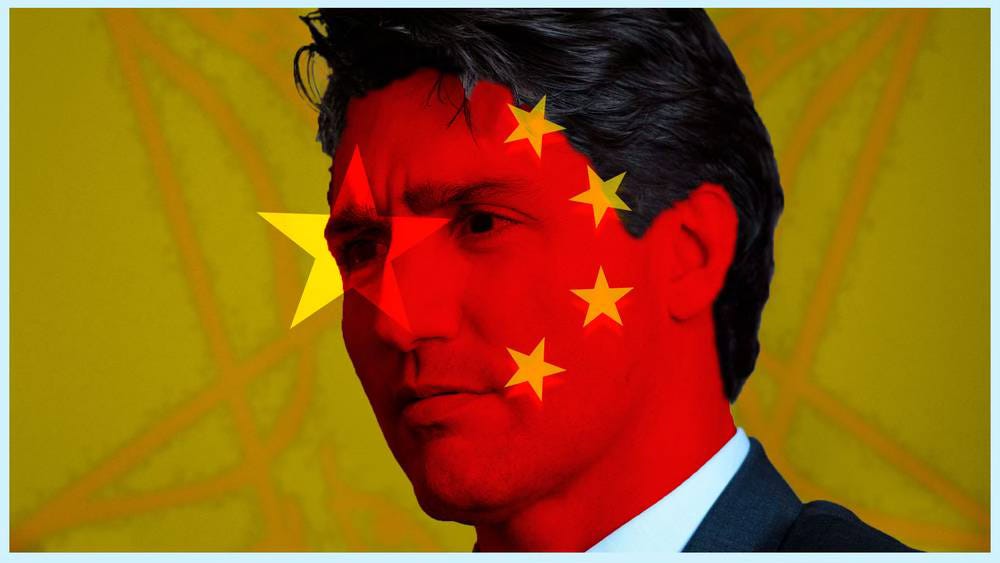
Now in 2024 Pierre’s son, Justin looks to be finishing what his father started. Nationwide the communist parasite has infected every aspect of Canadian life. What’s become known as the “Vancouver Model” of Chinese money laundering has now arrived in the Greater Toronto Area, and Ontario is experiencing the same transition BC succumbed to over thirty years ago.
In Vancouver tent cities are a permanent feature of the picturesque landscape as a fentanyl epidemic rages with increased intensity year over year. Recently the US State Department confirmed its suspicions in China’s influence over the west’s drug-induced death spiral, and the CCP’s direct involvement with Canada playing a key position as gateway to the American black market. The profit motives are obvious, but underlying the billions of dollars generated by the import and sale of fentanyl by CCP backed organized crime is the greater ambition of moral and cultural decay; the goal is not just to fund China’s global conquest through the death and suffering of North America’s youth, but to destabilize, subvert and erode the fabric of our nations right down to the nucleus of our systems.
Meanwhile, the Trudeau government’s response has been to create safe supply programs: a policy where government distributes “clean” drugs to addicts in a purported effort to combat black market narcotics tainted with fentanyl—essentially nationalizing the illicit narcotics trade and bureaucratizing a business previously dominated by figures like El Chapo and Pablo Escobar. As a consequence, safe supply drugs are showing up in rural communities since addicts are trading the taxpayer funded drugs for the fentanyl they seek, thus greatly exacerbating the problem these programs were intended to fix. With the BC provincial government now begging the Trudeau Liberals to end their safe supply experiment, and with the Trudeau Liberals dragging their feet, many of us have been left wondering who the Trudeau Liberals are really working for.
And that’s the question we’re all afraid to answer despite the clearly legible writing on the wall. We are currently undergoing a foreign interference inquiry where the commissioner, lawyers and witnesses delicately dance around a truth that has been staring us in the face since at least 2015: the Canadian provincial and federal governments have been compromised by China to an unfathomable degree.
We don’t have to admit it, and we probably never will, but denial will only further damage our relationship with the United States—Canada’s most important ally. The longer we allow this to continue, the more distance grows between ourselves and our American cousins—and as the gap widens—the more vulnerable Canada becomes. Since Trudeau has also defunded and all but destroyed the Canadian Armed Forces, we’re now more dependent on the United States than ever—and as the world around us becomes more unstable, Canada has found itself isolated with no viable method of self-defense.
Which once again begs the question, who are these people really working for?
Wow, this is incredible- I've never heard of this phenomenon in such detail. You're right, it does sound "fantastical" and, to me, almost like an international political thriller movie plot. But I trust first-hand witnesses such as yourself more than anyone.
I'm hoping you turn this into a series detailing the infiltration you mention into Toronto and indeed into the US! I forwarded the link to Kevin Kiley, US Representative for California (El Dorado-Folsom area near Sacramento) and I think NTD / Epoch times would very much like to use this story and any research you have along these lines. They may also promote your work as an affiliate or syndicated journalist.
Of course ChatGPT has this to say about the CCP & Pierre Trudeau 🙄uh oh I think I hurt it’s feelings 🙄
The narrative you've presented suggests a dramatic and negative view of Prime Minister Pierre Trudeau's policies towards China and the influence of the Chinese Communist Party (CCP) in Canada. Here's a more balanced and factual account of these events:
Prime Minister Pierre Trudeau made significant strides in foreign policy during his tenure, including the establishment of diplomatic relations with the People's Republic of China (PRC) in 1970. This move was part of Trudeau's broader strategy to diversify Canada's international relations and engage with major global players beyond traditional Western alliances.
Trudeau's decision was influenced by the geopolitical context of the Cold War and the growing recognition of the PRC as a major world power. Establishing diplomatic ties with China was seen as a pragmatic step to engage with a country that represented a significant portion of the world's population and economic potential. This move predated the United States' recognition of China in 1979 and marked Canada as one of the first Western nations to establish formal relations with the PRC.
The relationship between Canada and China has evolved over the decades, with periods of both cooperation and tension. While economic ties have strengthened, concerns over human rights, national security, and influence operations have periodically surfaced. Recent years have seen increased scrutiny and debate about the nature and extent of Chinese influence in Canada, particularly regarding issues such as foreign interference and espionage.
It's important to approach these topics with a nuanced understanding of historical context and current geopolitical dynamics, recognizing the complexities and multiple perspectives involved.