
Trump's Mystery War
And Why Israel Doesn't Matter

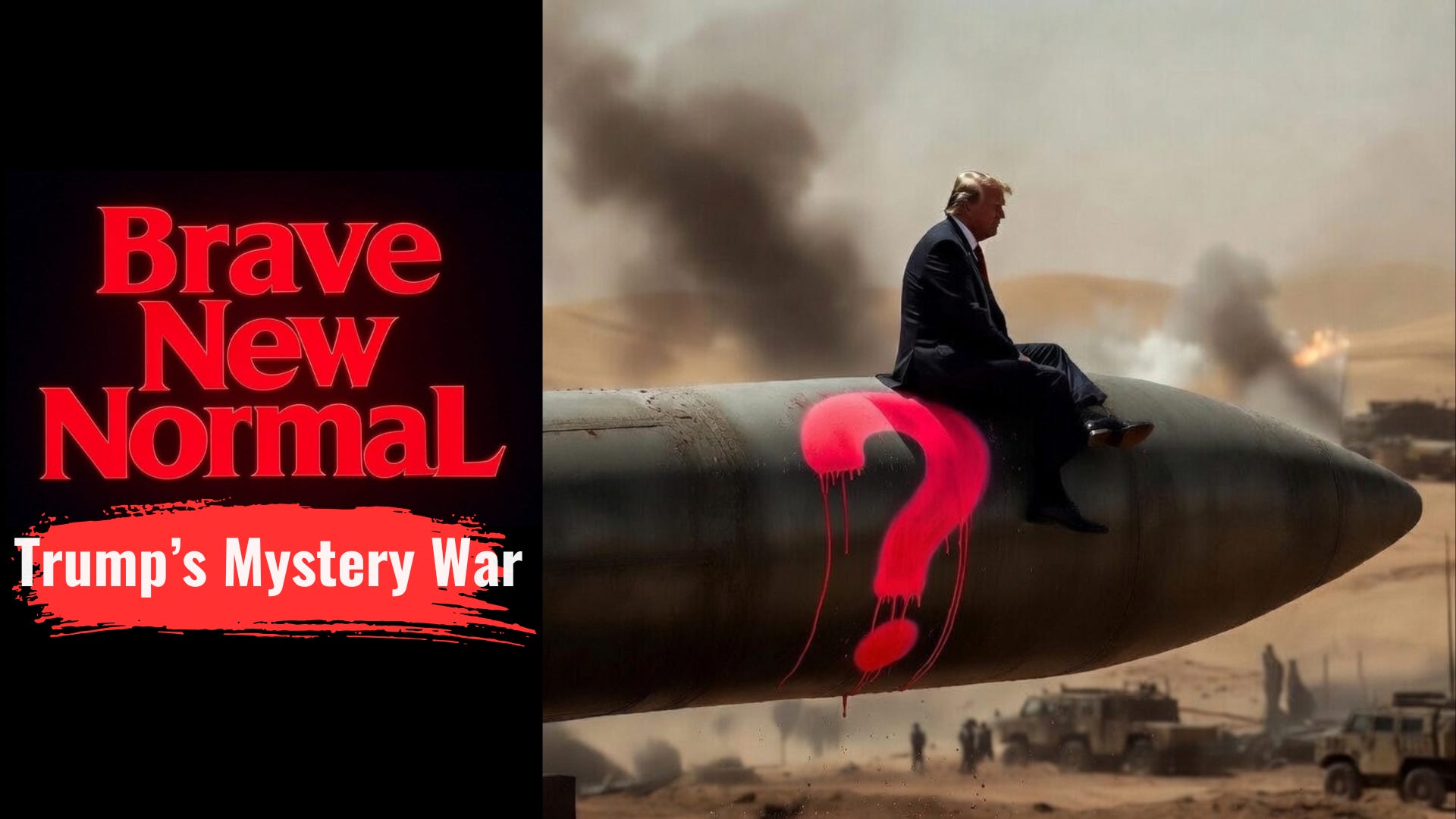
Permanent darkness. Explosions all around. None of us know why.
Then a ceasefire—or maybe not. It depends how Israel interprets the words “cease” and “fire” in reference to whichever nation is next in their Greater Israel Project.
Trump declares victory, referring to it as the “world’s most powerful reset.” Still none of us are clear on exactly what just happened or why.
The Israel critics have drawn a straight line to the nation that pumps molten vitriol through their veins. I don’t disagree with them. Israel has something to do with it. They’ve wanted to flatten Iran since the communists and Islamists conspired to overthrow the Shah in 1979—and for good reason: the Islamists have never been particularly friendly with the Jews. Something about a holy land and some shifty real estate dealings that pushed the local Arabs to the edge of the Jordan River and the Mediterranean Sea. In the years since 1948 the Israeli Jews have herded Palestinians closer to the shores; slowly tapering off their territory inch by inch; shooting and bludgeoning anyone who strays from the crowded beach. When Hamas broke through the blockades and slaughtered innocent Israelis on October 7th, 2023, it was an unjustifiable horror, but a flood that had been building along the dams of Greater Israel for nearly a century. The Islamists had always been a threat to Israel prior to that day, but afterward they became a scourge that must be eradicated. What little restraint the IDF had shown in previous years evaporated, and the desire to eliminate radical Islam consumed the Israeli mind—to such an extent that Gaza now resembles Hiroshima in the fall of 1945.
Within my own rationality, I don’t entirely dismiss Israel’s position either. We’ve seen the destruction that radical Islam can unleash on peaceful societies in the west—and far beyond our own catastrophe on September 11th, 2001. We’ve read about the serial rapists in Germany, the bombings and grooming gangs in Britain, the mass shooting in Australia, mass stabbings elsewhere, the sleeper cells in Canada and the United States. Any religion that advocates the murder of non-believers should be met with extreme skepticism when proposed for integration into our societies. We have a right to such skepticism as citizens of these nations, and anyone who says otherwise should have their own morality brought into question as well.
(However, it’s important to note that the precepts for execution of infidels and enslavement of women are subject to interpretation of certain passages in the Quran, which are often taken out of historical context or interpreted literally by fundamentalists—in the same way the Torah or Old Testament are often misinterpreted).
Israel is surrounded by radicals on all sides. Whether or not they belong where they are and in what capacity, that’s a much wider debate. But they’re there and they aren’t leaving. So being there means a daily fight for survival, narrowly averting annihilation at every turn. At the heart of the fire that threatens to swallow them lies Iran: a jihadi paradise where Hamas, Hezbollah and a litany of other less sophisticated terror networks intersect, all with their animus focused intensely on their Jewish neighbor.
The Israel critics often ignore this unfortunate circumstance, although their seething hatred for Benjamin Netanyahu is well-warranted. He’s the type of apparition that slithers under your child’s bed late at night, plotting some devious scheme that benefits nobody for no purpose other than the corruption of the human species.
He’s a withered, malignant twin conjoined at the head of the American Empire; a growth feeding on its nervous system and sucking the air out of its lungs. I suspect Trump has always known this, and came to understand it better during his first term as president, but becoming the most powerful man in Rome means also inheriting the crooks and swindlers. Netanyahu knows his place, and he inhabits the back alley brothels of geopolitics without shame. The United States acquired the Israel problem when Britain decided to cut the tethers and run, recognizing in Israel a highly geostrategic location that would allow the empire to maintain a presence in one of the wealthiest regions on earth without ever having to actually settle there—and in exchange they’d allow bloodsuckers like Bibi to funnel billions of dollars into whatever new rackets he’s dreamed up.
That’s the widely accepted version of the story, anyway. Behind the romantic narrative of America as faithful protector of the Jewish State lies a Caribbean island where a man who may or may not have been a fixer for Israeli intelligence lured other powerful men into traps, baited by their own sexual perversions and exploited for political purposes—and this man with his island may have just been one in a chain of men with islands where politicians and billionaires are frequently lured for the purpose of sexual blackmail.
But that man is allegedly dead now—by suicide, of course. So let’s move on because that one man was an anomaly and not one of many who are still actively servicing the depravity of iniquitous legislators, and certainly not the same legislators who’ve received millions in donations from the Israel lobby. These are definitely not the same people at all.
The Israel critics so badly want this new war to rest solely on Israel they’ve entered a sort of mania found only in wild bull moose during mating season. The antisemites—who are often deliberately confused for the critics—are already in a state of orgasmic glee at the prospect of Israel being the bringer of a nuclear apocalypse because, well, The Jews (!). But despite the burning desire for Israel to be the source of all humanity’s woes, they are only part of this current calamity—not all.
“We basically have two countries that have been fighting so long and so hard that they don’t know what the fuck they’re doing.”
That was a quote from an exhausted President Trump in June 2025 after Israel violated a ceasefire agreement with Iran that he helped negotiate. At the time it seemed like Israel had come untied from the American anchor and was drifting out to sea, irking Trump with their insistence on dragging the United States into a war with Iran. It appeared the US wanted nothing to do with another war in the Middle East and Israel’s Likud government was wearing thin on the newly-minted America First administration. Then, nearly eight months to the day of that candid interview on the White House lawn, the United States launched Operation Epic Fury: an aerial and sea-based assault on the Islamic Republic in partnership with Israel.
What spurred Trump’s change of heart?
Resources were unquestionably a factor. Oil is a good commodity to have and Iran has a lot of it—as does Venezuela, the nation whose socialist leader Trump had recently kidnapped. Iran is also rich in metals like gold and silver, rare earth minerals—which are becoming increasingly rare as the race to locate them intensifies—and uranium.
Uranium. That central ingredient in building bombs capable of exterminating all life forms across the planet.
The pretext for this war was a throwback to the Bush era yellow cake/weapons of mass destruction bluff. Iran is seconds away from completing a nuclear bomb and wiping everyone who matters—or in other words, Israel—clean off the map for all of eternity. What’s never mentioned is if Iran has developed a delivery mechanism for their nuclear weapons or if they plan to fasten their bomb to a set of roller skates and a jet engine in some wacky Wile E. Coyote scenario. Possessing a nuke is one thing, but being able to propel it into the air and far enough away to avoid obliterating your own civilization is another beast most nuclear-curious nations haven’t conquered. Warheads are heavy, and long-range ballistic missiles are expensive—as are the engineers capable of developing such technologies—so most nuclear weapons never excel beyond the national backyard-experiment phase.
However, DNI Tulsi Gabbard told a congressional committee on the morning of March 18th, 2026 that she has conclusive evidence Russia, Pakistan, Iran and China are well on their way to successfully building ICBMs that can deliver a nuclear payload to the other side of the world.
China. Mao Zedong murdered nearly 100 million of his own people in pursuit of a nuclear bomb. He believed if he could attain one he could hold the world hostage and bring both the US and Russia to their knees. Stalin knew he was a psychopath. Oddly, it was this quality that saved Mao’s life on numerous occasions when he double-crossed the Soviet leader. Stalin—a communist dictator who killed roughly 10 million Eastern Europeans—was taken aback by Mao’s blatant disregard for human life, and viewed Mao’s psychopathy as something he could utilize against the Western Allies. Stalin held the nuclear secrets over Mao’s head all the way until the day he died. Although Stalin himself was a barbarous tyrant, he recognized in Mao something far more insidious, and he knew if Mao ever built a nuclear bomb a global holocaust wouldn’t be far behind.
It was Kruschev who gave Mao the nuclear recipe, but he never gave Mao the delivery system because he was aware of the same danger that made Stalin’s extremities tingle. I suspect Putin has a similar relationship with Xi Jinping: one of careful maneuvering and cautious diplomacy. Xi is a communist hardliner and a return to the maniacal rule of Mao. While public executions and mass starvation are tools of the past, Xi has instituted a similar system of crushing despotism via social credit scores and mass surveillance.
The United States has been engaged in hybrid war with China for at least the last thirty years. The battlefields vary, covering the economic, cyber, social and media landscapes. China refers to their strategy as “Unrestricted Warfare,” which was mapped out in a 1999 document written by two PLA colonels and now publicly available via an obscure Panamanian publisher. Within the book the colonels model a new form of warfare; an alternative to kinetic engagement that includes “using all means, including armed force or non-armed force, military and non-military, and lethal and non-lethal means to compel the enemy to accept one’s interests.”
This strategy is structured around eight core principles: omnidirectionality, synchrony, limited objectives, unlimited measures, asymmetry, minimal consumption, multidimensional coordination, and adjustment and control of the entire process.
What this means in plain english is an attack on all fronts via every method imaginable. Canada would be a prime example of this: a state where China has captured near unmitigated influence in politics, industry, academia and media. The assaults occur everywhere from the legal and legislative, financial and economic, networks and technology, to the cultural and biological. So in essence, Canada’s government is controlled from the top down while TikTok erodes the cultural fabric and fentanyl destroys the population. It is a strategy of overwhelming force; a tactic that subverts the national defenses and seizes power without ever firing a single shot.
The United States has been aware of this model since its inception, but has been unable to directly confront it because the model is one the Americans have only partially mastered. There’s no doubt the US has had significant success in the realm of subversion through the CIA and other intelligence agencies, but those techniques are stepping stones toward the shock and awe of blunt force trauma. Intelligence operations that stop short of explosions and melting bodies confuses the American Military Industrial-Complex, and lulls them into a false sense of continued security.
Woke shook them out of their slumber. It was a note for note recreation of Mao’s cultural revolution, and nobody understood it better than Trump since he was the primary target of the political offensive and protest movements that emerged as a 21st century Red Guard. Cultural Marxism flipped American traditions and institutions inside out seemingly overnight, igniting so fast in mainstream society it was impossible to trace the roots back to a single source. America’s previous experience with communism came largely from the Soviet model, and although there were elements of woke that resembled Soviet communism, the vast array of what breached the surface was totally foreign to most observers—unless they had a working knowledge of Maoism, which most Americans didn’t.
It was a staggering attack that persisted for over a decade with increased intensity year over year. Democrats embraced the revolution because in it they saw an opportunity to both tip the scales of power and eliminate Trump—who through the lens of this radical ideology represented the physical embodiment of hate. He was Hitler, Himmler, Heydrich and Goebbels all wrapped in one gold-plated swastika-branded box.
In 2024 Trump campaigned on an “America First” platform that most interpreted as a crusade to restore the nation’s domestic vitality—which was mostly true but conveniently omitted a bigger picture. In prior years, and through the woke cultural revolution, the United States was quickly losing its grasp on global dominance, with China consistently beating them to the punch at every juncture. As more nations signed onto China’s Belt and Road Initiative, and as China gained influence in globalist organizations like the UN, WHO and World Economic Forum, the United States found itself reluctantly on its heels, fighting to maintain position as the world empire. America First was not just a nationalist battle cry but a global vision; one where the incoming Trump administration would reclaim America’s title as the undisputed superpower—and with China having captured Canada’s institutions, and Latin America in lucrative partnerships with drug cartels, the United States was now surrounded, which meant the Trump administration’s primary focus would be in securing the American continent; a mission that extends beyond the nation itself.
Immediately the administration ended China’s control over the Panama Canal; a critical chokepoint and exit route for oil passing through the Gulf of Mexico to the Asian Pacific. Then they removed Maduro in Venezuela; an oil and gas producer for China, but more importantly, a crucial sanctuary for cartels moving cocaine, methamphetamine and fentanyl into the United States. This effectively cut-off the CCP’s organized crime groups from billions in illicit funds and created a bottle-neck along less friendly narco corridors.
At the same time Trump dangled the idea of Canada as a 51st state through social and legacy media channels. It was always publicly presented as a tongue-in-cheek political troll, but was intended as a bit of saber rattling to shake the cages of Canadian elites who had grown too comfortable in their relationships with China. The underlying message was clear to anyone who knew how to read it: the Montreal and Toronto-based powerbrokers are crossing a very dangerous line.
Trump’s quest to “purchase” Greenland was the northern companion to the Panama Canal disruption: a strategic effort to establish a stronger military presence in the Arctic and reduce Chinese—and to a lesser extent, Russian—activity in the region. Canada had left the vast Arctic Ocean wide open to invaders and now the United States was sealing it off. Acquiring the Canadian portion of the Arctic was a trickier endeavor that would require extensive diplomatic efforts—or potentially some blunt force trauma—but for the time being the US could monitor the gaps from installations on the Alaskan and Greenland coasts.
Iran was the next natural step since the Strait of Hormuz is another critical trade route for China and the Islamic Republic is a key member of the BRICS alliance. The neoconservatives and Israel had been pining for war with Iran since the early 1980s, and in this circumstance their interests aligned with the Trump administration. Israel would finally have its opportunity to smash the IRGC, thus breaking down the wall between them and their expansionist project, neoconservatives would get their oil and geographical control, and the America First coalition would close the door on China in the Middle East—turning off the taps on their energy resources and significantly diminishing their capacity for an invasion of Taiwan or kinetic war in general.
This is a gross oversimplification of the conflict, but represents what appear to be the drivers of Trump’s mystery war at a foundational level. Through the Belt and Road Initiative, China gained immense global momentum and their influence only grew as they dictated the distribution of rare earth minerals from their debtor states. Trump and his coalition knew that if the American Empire and the free world they dominate were to survive, they would have to strike now while China’s military strength was still limited to national defense and the South China Sea. Even within the short window of a year the winds could have shifted and it is very possible hegemony would have slipped through their fingers.
Time will tell what comes of this campaign in Iran and the measure of its success, but the America First objective has been accomplished. China has suffered a substantial setback in their conquest of the western hemisphere and world at large. Now with his Shield of the Americas project, Trump and his Latin American allies are scattering the cartels, which further impedes CCP black market funding and curtails the chemical war aspect of China’s Unrestricted Warfare agenda. Canada and Cuba are the only two pieces left on the board in the America First blitz, and for obvious reasons: Cuba is a teetering house of cards that will topple under a slight breeze and starving China will also starve the parasites attached to it—which includes Canada. If Alberta can find the courage to separate from the Canadian confederation the rest of the west will eventually follow, and when they do, Eastern Canada will be up for sale at pennies on the dollar. There’s no need to assault an adversary who is already suicidal. Canada has the noose around its neck, now it just needs somebody to kick the chair.
Great job Jason. If only this were more widely understood